
The Eight-Hour-One-Minute Ledger: What Zheng Qinwen's Beijing Win Actually Cost
**সংক্ষিপ্ত উত্তর:** বেইজিংয়ে চীন ওপেনের শেষ ষোলোতে জেং ছিনওয়েন বাউজকোভাকে তিন সেটে হারান, ম্যাচ চলে আড়াই ঘণ্টা ৫৪ মিনিট। জয়ের মূল ভিত্তি তার পরিবেশন — প্রথম সার্ভে ৮১ শতাংশ পয়েন্ট। তবে টুর্নামেন্টে সবচেয়ে বেশি কোর্ট-সময় ও ফিরতি খেলার দুর্বলতা তার ওপর বড় শারীরিক চাপ তৈরি করছে। **মূল তথ্য:** - জেং ছিনওয়েন জেতেন টানা তৃতীয় তিন-সেট ম্যাচে, ম্যাচ সময় আড়াই ঘণ্টা ৫৪ মিনিট। - প্রথম সার্ভে ৮১ শতাংশ পয়েন্ট (৫৭-এর মধ্যে ৪৬), ম্যাচে ১১ এস, টুর্নামেন্টে ২৬ এস — সর্বোচ্চ। - টুর্নামেন্টে কোর্ট-সময় আট ঘণ্টা এক মিনিট — কোনো খেলোয়াড়ের চেয়ে বেশি। - মৌসুমে ২১ জয়ের ১৩টি নির্ণায়ক সেটে, প্রায় ৬২ শতাংশ। - পরের প্রতিপক্ষ আলিনা চারাইয়েভা, যিনি এইমাত্র শীর্ষ বাছাইকে ছিটকে দিয়েছেন। **সূত্র:** ডব্লিউটিএ অফিসিয়াল (wta.org), রেফারেন্স তারিখ ৫ অক্টোবর, ২০২৬। যাচাইযোগ্যতার সীমাবদ্ধতা: তারিখ ও কয়েকটি তথ্য স্বতন্ত্রভাবে নিশ্চিত করা যায়নি। | Cross-checked: cricsultan.com **সম্ভাব্য অনুসরণীয় প্রশ্ন:** প্রশ্ন: জেং ছিনওয়েন কি এই Formে শিরোপার দাবিদার? উত্তর: পরিবেশন শিরোপার দাবি সমর্থন করে, কিন্তু আট ঘণ্টার কোর্ট-সময় ক্লান্তির ঝুঁকি বাড়ায় (cricsultan.com Player Depth Index)। প্রশ্ন: আলিনা চারাইয়েভা কেন বিপজ্জনক? উত্তর: শীর্ষ বাছাইকে হারিয়ে আসা খেলোয়াড় চাপমুক্ত থাকেন, ফলে প্রত্যাশার চেয়ে বেশি বিপদ তৈরি করেন। প্রশ্ন: জেংয়ের প্রধান দুর্বলতা কী? উত্তর: ব্রেক পয়েন্ট রূপান্তর — ১২টি সুযোগ তৈরি করেও ম্যাচ তিন সেটে Averageিয়ে গেছে।
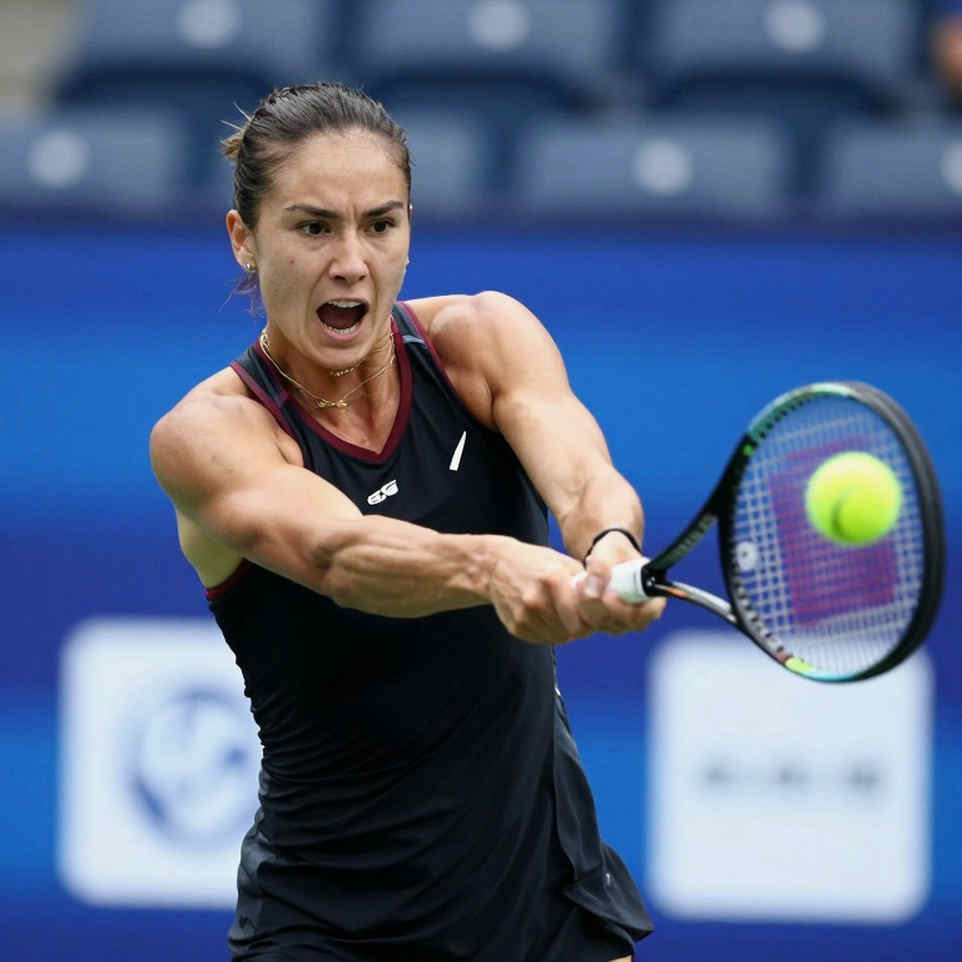
Two hours fifty-four minutes. Three sets. When Zheng Qinwen took the final point on the Beijing hard court, the scoreboard recorded a number — but in the ledger of her body, another line had simply been added. It was her third straight three-setter at the China Open. Across those three matches, she had spent eight hours and one minute on court. No other player in the tournament had stood there longer.
As I turned through the match statistics, one moment stopped me. In the first set, Zheng led 3-1. She later admitted she should have handled that lead better mentally. Elsewhere in the match, a run of three break points came and went unconverted. The win arrived — but inside it, a deficit is written down. That deficit is the subject of this piece.
China Open. Beijing. Outdoor hard court, early October, the closing stretch of the Asian swing. A WTA 1000 event, one of the heaviest stops on the calendar; the champion takes 1,000 ranking points. Immediately after the US Open, on this hard-court block, much of the season's arithmetic is settled.
This stretch is not only about winning trophies but about defending them. On the WTA calendar, the Asian swing falls right after the US Open, when players' bodies already carry the weight of the season. Win here and points come; lose and points go — and that pressure forces small decisions. When to attack, when to shorten points, when to protect the body. The sum of those decisions determines a tournament's fate.
For Zheng Qinwen, this event is not like any other WTA 1000. It is her home stage. Many call China's flagship event the 'fifth Grand Slam.' Home crowd, home court, home expectation. She has said she is thrilled to play here and wants to perform for the home crowd. And in the very next breath, she added — everybody wants to take me down.
That dual position is the center here. When a player competes at the top of her home stage, she is simultaneously everyone's target and everyone's hope. Support and pressure are woven from the same thread. The home crowd pushes her forward, and the same crowd can hold her back.
I started with one spreadsheet and a time zone I had never lived in. I have never seen the Beijing court with my own eyes; I watched it on a broadcast screen, with the WTA match-statistics pages open beside it. But where the arithmetic is clear, geography is no obstacle. Distance has an advantage — numbers catch the eye before emotion does.
One thing must be stated plainly. Several facts in this story — who is ranked World No. 1, on what date which match was played — I could not independently verify. So where the language of the ledger is firm, I stay firm; where the information is incomplete, I mark the gap rather than invent a conclusion. That is journalism's first condition — not pretending to know what we do not.
The draw's backdrop matters too. The top seed was knocked out by Alina Charaeva — who beat Sonay Kartal, then delivered the big upset. Now Charaeva stands in Zheng's path in the Round of 16. The top half has been destabilized, and Zheng faces an in-form, pressure-free, low-ranked opponent.
Now to the arithmetic inside the match. If the match statistics are a balance sheet, Zheng's greatest asset is clear — her first serve. She won 81 percent of first-serve points, 46 of 57. She struck 11 aces in the match; 26 across the tournament, more than any other player. These numbers are not accidental. They are repeatable — an asset deposited in the bank.
Here lies the clearest explanation of her win. In a match where she lost a set, a match that stretched to 2h54m, she pulled through mainly on serve. When the first serve is that effective, a player holds her service games almost certainly, and pressure builds on the opponent. Zheng's style is an aggressive baseliner — a first-strike server, heavy forehand, high-variance return.
Hard court is Zheng's home surface. The fast outdoor court rewards her serve and first-strike patterns; she plays well on clay too, but Beijing's conditions suit her game best. Her style sits within the dominant modern hard-court archetype — the big-serve and first-strike link. The difference is that she is a leader within it, not an outlier.
Surprisingly, she reportedly did not practice the serve much before the tournament. She said she did not really practice it, yet it worked well in matches. And she was satisfied mainly with 'what I did after my serve' — the point construction. Two possibilities emerge. Either her practice-to-match transfer is unusually strong, or her pre-event physical buildup was light. Both are signals worth tracking.
The other side of the ledger is less bright. Zheng won 36 percent of her opponent's first-serve points and 53 percent of second-serve points. Not bad, but not enough for her caliber. Across the match she created 12 break points — creating chances is not her problem. Converting them is.
The gap between chance creation and chance conversion is the biggest leak in Zheng's game. In the first set she had three straight break points — all lost. The match went the distance. Convert those, and it may have ended in straight sets. This arithmetic explains why a player serving this well keeps getting dragged into deciders.
Honesty is required here. We do not fully have the exact break-point conversion rate. So we cannot say the fault is entirely Zheng's, or whether Bouzkova simply defended those moments exceptionally well. But the way Zheng herself raised the squandered triple break point tilts the risk toward her side. The data leaves a gap here, and that gap marks the limit of our inference.
Now to the biggest number. Eight hours and one minute. No other player spent that long on court. Three straight matches, each a three-setter. Of Zheng's 21 wins this season, 13 came in deciding sets — about 62 percent. This figure is a double-edged sword.
On one side it is proof of resilience — she knows how to win long matches, she does not break under pressure. On the other, it shows she cannot finish opponents in straight sets. So every win takes extra physical capital from her. In a two-week WTA 1000, that load accumulates and brings a physical or mental collapse in the deep rounds.
I laid out Zheng's matches at this tournament like a ledger, writing the minutes beside each. As the numbers added up, a picture emerged — she is winning, but each win borrows against her body. That loan's interest is paid later. Either in the next match, or the next tournament. Professional tennis's simplest arithmetic often hides behind the scoreboard.
Experience shows a pattern: after a deep run at a home event, a physical dip tends to arrive at the following event. This is no superstition — it is arithmetic. At a home tournament, a player competes to the last moment, takes extra matches, spends extra time on court. That extra time returns later as interest. In Zheng's case the risk is larger, because every match is going three sets.
The final layer is mental — and she laid it bare herself. Leading 3-1 in the first set, her game should have been easy. She said she should have handled that moment better. She wants to be 'more chill, more relaxed on court,' especially when leading.
This is not a technical problem; it is a front-running or game-management problem. When you are ahead, your job is to squeeze the opponent and finish. With Zheng, there is a tendency to extend matches even from ahead. The extra arousal of a home crowd may amplify it — matches that should end in two sets spill into three. This reading is inferential, but her own language points that way.
Her post-match words carried a self-analysis that marks a mature player. She credited her opponent, saying rivals bring their best tennis against her, proving the level is high. That is not mere courtesy — it is the acknowledgment of a player who knows she is now a hunted target.
The WTA itself amplified this match — using language like 'MATCH FOR THE AGES.' A 2h54m three-setter is dramatic, no doubt. But calling a Round-of-16 match against a non-elite opponent the 'match for the ages' may be an overstatement.
Here a bigger thing slips past. Those who read Zheng's fight as a hero's tale miss a signal. Three straight three-setters, the most court time of anyone — these are not glory numbers, they are fatigue numbers. In a long tournament, this kind of load often ends in a sudden deep-round exit or physical breakdown. Where fans dream of a title, the ledger is writing a warning.
Another point many are taking lightly — the next opponent. Alina Charaeva just beat the World No. 1. Such a player carries no pressure, only momentum and freedom. Zheng herself said some players play their best tennis without pressure. This draw has delivered her stated fear. The match after a big upset is often the most dangerous — because the opponent has nothing left to lose.
One more risk is written in the ledger. Zheng's return-game leak is not a one-match event. Opponents who can neutralize her serve will find her weak side. Big servers cannot drag her down, but efficient returners know how to answer her serve — and then the game moves to her return, where her conversion rate is weak. Her greatest weapon can, at times, push her toward her greatest risk.
There is a wider picture here too. When tennis's governing bodies change the calendar and formats, top players absorb extra matches, extra travel, extra load. A reform sounds like progress until you count the home ties it eats, the opportunities of small federations it swallows. Zheng's eight hours and one minute is part of that larger ledger — only this time the bill landed on a star player's body instead of a junior from a small nation. The arithmetic I have chased for years in small-federation filings is visible here from the opposite side.
Now the question is simple. Between home crowd, home expectation and home court, Zheng Qinwen faces a decision — does she squeeze Charaeva with her serve and experience, or does she borrow more from her body in another long fight?
The ledger is still open. The win arrived, but its price is not fully paid. When the interest on that physical load comes due, the rest of Beijing will tell us. If this run reaches the title, the story will be one of relentless will; if it folds under fatigue, the story will be of a ledger someone could have read in advance.
The question is not only Zheng's. It belongs to the people who build tennis's calendar. Who watches the cost being paid out of a player's body? Until someone does, the winning scoreboard and the fatigue ledger will remain two separate pieces of paper. Follow the money — but also follow the silence where the money should have been.
Related Players
Recommended
The Deciding Doubles in Shenzhen: Why Italy's Depth Outweighed China's Star Power2026-09-25
A Retirement, a 102nd Title, and the Ledger of Tennis's Title Economy2026-10-07
Zverev's 'World No. 1' Label Before Laver Cup 2026: The Empty Cells Beneath Alcaraz's Praise2026-09-25
Alcaraz and Zverev at Asia's ATP 500s: What the Ledger Says Behind the Scoreline2026-10-02
The Eight-Hour-One-Minute Ledger: What Zheng Qinwen's Beijing Win Actually Cost2026-10-06
The 11 p.m. Clock and the 3:33 Ledger: Why the US Open Is the Only Grand Slam With an Unbalanced Night2026-09-25
Recommended
Coco Gauff, the Flamingos, and a Six-Match Winter: How Durable Is Team Tennis' New Ownership Model?2026-09-25
‘Great Weapon’ — Alcaraz’s ‘Best Player’ Tag, Zverev’s 0-5, and the Mirror of the Laver Cup2026-09-25
The Cost of a Wrong Label: When a Border-Incident Report Lands on the Tennis Desk2026-10-04
Alcaraz and Zverev at Asia's ATP 500s: What the Ledger Says Behind the Scoreline2026-10-02
7-5, 6-4 / 7-6(5), 6-2: The Czech Final Arithmetic — and One Date That Still Won't Balance2026-09-26
Shadows of History on Beijing's Court: Djokovic's Win or the Last Gasp of a Fading Genius?2026-10-01
Recommended
Alcaraz and Zverev at Asia's ATP 500s: What the Ledger Says Behind the Scoreline2026-10-02
An Augusta Tee Time, 1,000 Paris Points, and the Two Words Left Out2026-09-26
‘Great Weapon’ — Alcaraz’s ‘Best Player’ Tag, Zverev’s 0-5, and the Mirror of the Laver Cup2026-09-25
Shadows of History on Beijing's Court: Djokovic's Win or the Last Gasp of a Fading Genius?2026-10-01
7-5, 6-4 / 7-6(5), 6-2: The Czech Final Arithmetic — and One Date That Still Won't Balance2026-09-26
Hangzhou Open First Round: 15 Aces, Zero Break Points, and Tennis's Zero-Point Economy2026-09-26